
February Newsletter
To start 2026 I’ve been working hard up at the River Song property - the gardens needing more water than usual, and the studio mid-renovation. We’ve had a couple of high fire-warning days, but thankfully nothing major. It’s a remarkably wet mountain most of the year, yet having been in Hawaii during the Maui fires, I’m very aware of how vulnerable a town with a single road in and out can be.
On catastrophic fire days, it’s clear the Melbourne studio is the safer place to be. And from there, I’ve been finishing a new body of work I’m excited to share with you.
These pieces are deeply tied to the River Song gardens and have been quietly marinating since spring (you may remember some of the reference photos from a previous newsletter). Most of you know my long-standing love for Japanese maples and sakura blossoms, but lately I’ve fallen for rhododendrons, snowball trees, and azaleas. They know exactly how to usher in a new tree-calendar year.
Below are the latest works: Rhododendron, Viburnum opulus, and Peering into Spring.
As always, I’ll be giving away a small painting on paper to one random subscriber this week. If you know someone who might enjoy these updates, feel free to share this email or the website with them.
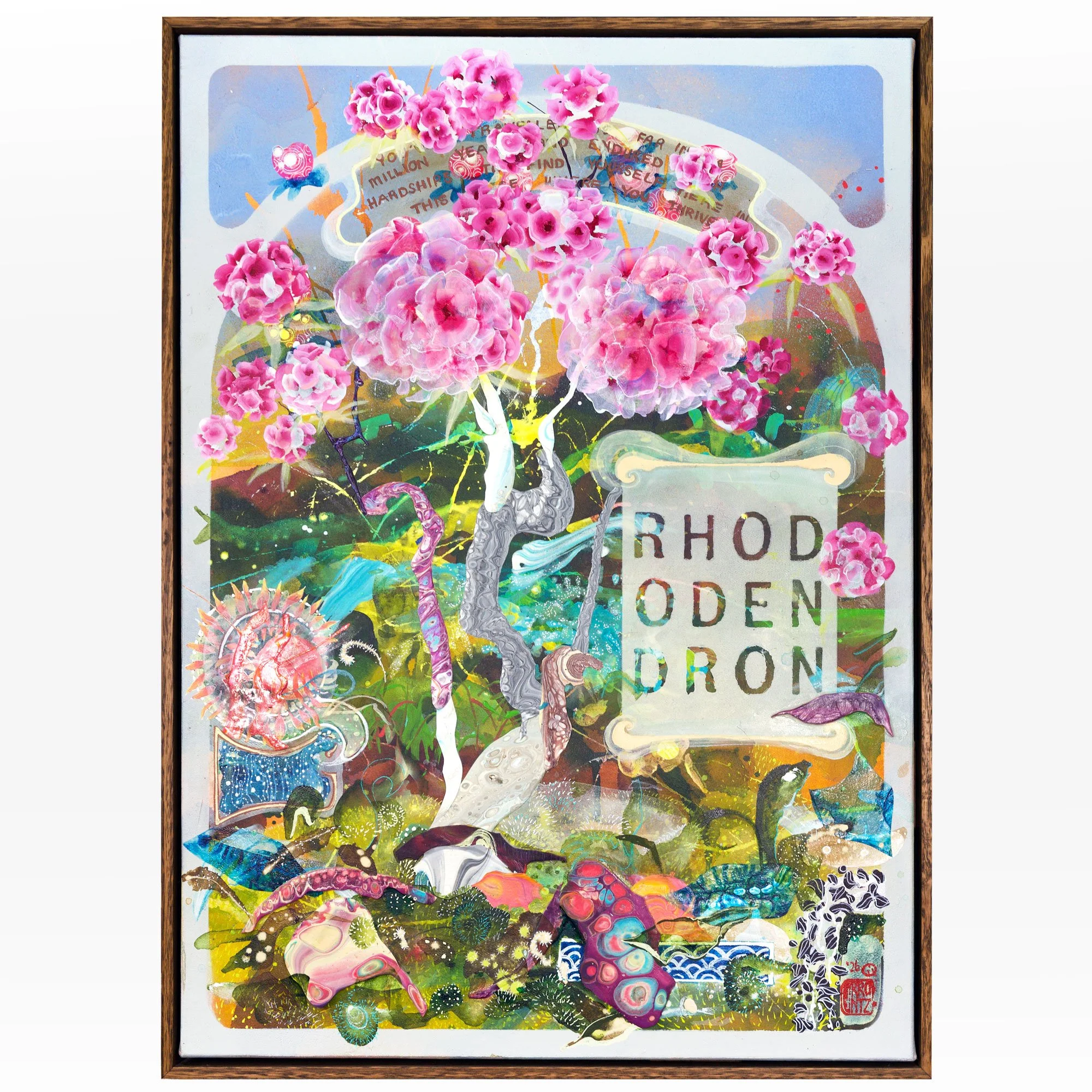
‘Rhododenron’ 70cm x 50cm, acrylic on canvas
Rhododendron continues my Art Nouveau series, inspired by both the trees in my garden and the work of artists such as Alphonse Mucha. In these paintings, I replace the female figure typical of Mucha’s compositions with botanical specimens. The plant becomes central, monumental and framed by decorative line and typography.
Rhododendrons are an ancient genus, with evolutionary origins stretching back millions of years. Many species developed in mountainous regions such as the Himalayas, adapting to cold, altitude, acidic soils and shifting light. Their thick evergreen leaves and dense clustered blooms are not delicate gestures, but structures shaped by endurance.
The text embedded in the upper section reads:
“you’ve travelled so far in a million years and endured such hardships to find yourself in this place where you thrive.”
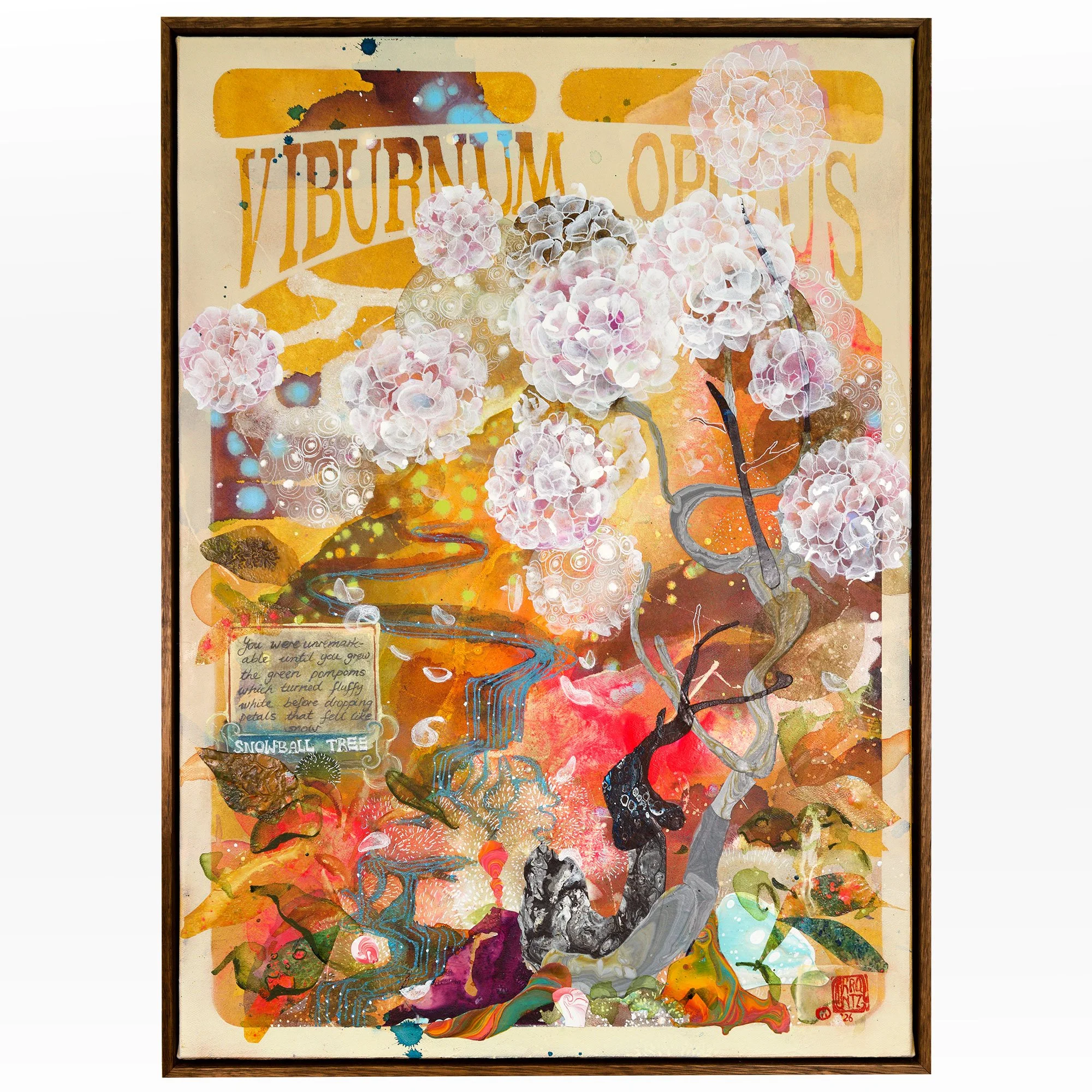
‘Viburnum Opulus’ 70cm x 50cm, acrylic on canvas
Viburnum Opulus is part of a series of paintings that draw on the visual language of Art Nouveau and early twentieth-century poster design. In these works, trees and plants take on the compositional role often given to figures in artists such as Alphonse Mucha. i.e I paint trees, and Mucha women (usually). The snowball tree’s spherical blooms provide a natural geometry that lends itself to repetition and rhythm. Curving stems and branching lines echo the sinuous forms associated with Art Nouveau, while the inclusion of the Latin name references botanical plates and vintage printed matter.
The snowball tree is a part of my garden, and being new to the property, I again thought it was something entirely different until spring. The text on the painting reads: “You were unremarkable until you grew the green pompoms which turned fluffy white before dropping petals that fell like snow”.
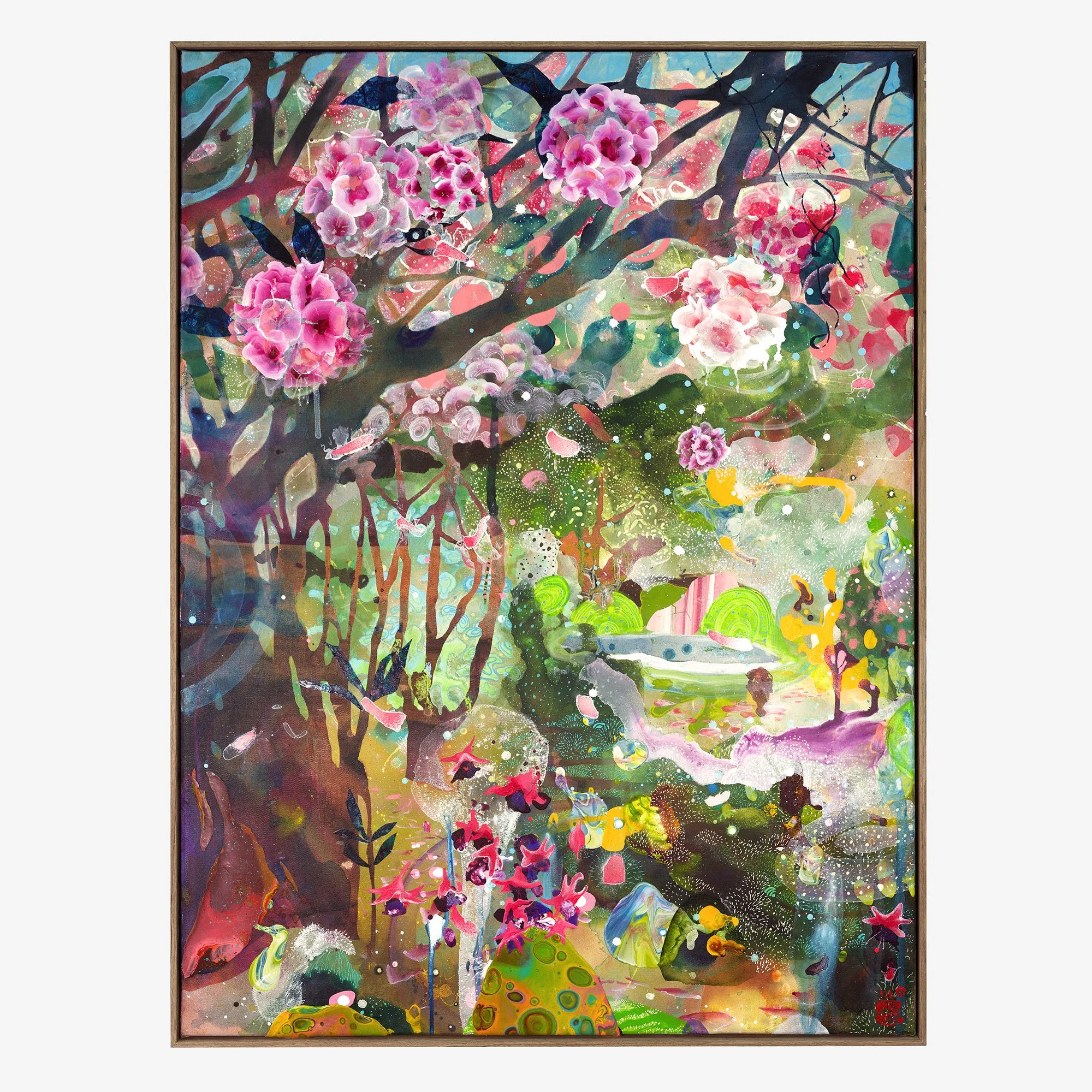
‘Peering into Spring’, 100cm x 75cm, acrylic on canvas
Peering into Spring was inspired by a familiar vantage point in my garden in the Upper Yarra Ranges. The view looks down a narrow pathway towards the pond, framed by rhododendrons that form both a canopy overhead and strong vertical lines anchoring into the ground.
This moment captures early spring, when the rhododendrons, azaleas and fuchsias come into full display after a long, cold mountain winter. It was the first spring I experienced on the property, and I was struck by the contrast between the restraint of winter and the intensity of the bloom. For most of the year these plants hold their structure in muted greens, enduring frost, heavy rain and short days. Then, almost abruptly, they announce the turn of the season.
Peering into Spring reflects that turning point: the resilience required to endure winter, and the explosive growth that signals renewal. It is both an observed landscape and a record of seasonal change.